Nottingham is a prime location for property investment, presenting a fantastic opportunity for those interested in the buy to let market. The city offers a dynamic rental scene, a thriving economy and significant regeneration projects. With a growing population and a strong student presence, the demand for quality buy to let properties in Nottingham is consistently high, making it an attractive city for both new and experienced investors looking into Nottingham property investments.
Last updated: July 2026
Ipswich property investments work if you want reliable rent coming in every month rather than a fast profit when you sell. Property costs less here than in the towns closer to London, so your deposit is smaller and the rent you collect is worth more against what you paid for the property. Average prices are around £267,000. The cheapest postcodes, IP1 and IP2, pay the most rent for what you spend. This page covers what you’ll pay by postcode, what rent and yield look like, the regeneration behind tenant demand, our Ipswich development and how to buy with a 5% reservation instead of a full deposit.

| The term | What it means in practice |
| Affordability | Property in Ipswich costs less than the towns closer to London. Lower price, smaller deposit, lower barrier to a first purchase. |
| Steady yield | Rent is high as a percentage of a low purchase price, so the monthly money coming in looks good against what you spent. |
| Slow capital growth | The property won’t jump in value. Buy at £230,000 and don’t expect to sell at £300,000 next year. |
An Ipswich buy-to-let is closer to holding a dividend-paying share than a fast-moving tech stock. The benefit is that you get returns monthly as opposed to the day that you sell, which gives you a more stable income source.
Ipswich is a good place to invest in property if your priority is rental income and you can hold onto the property for several years.
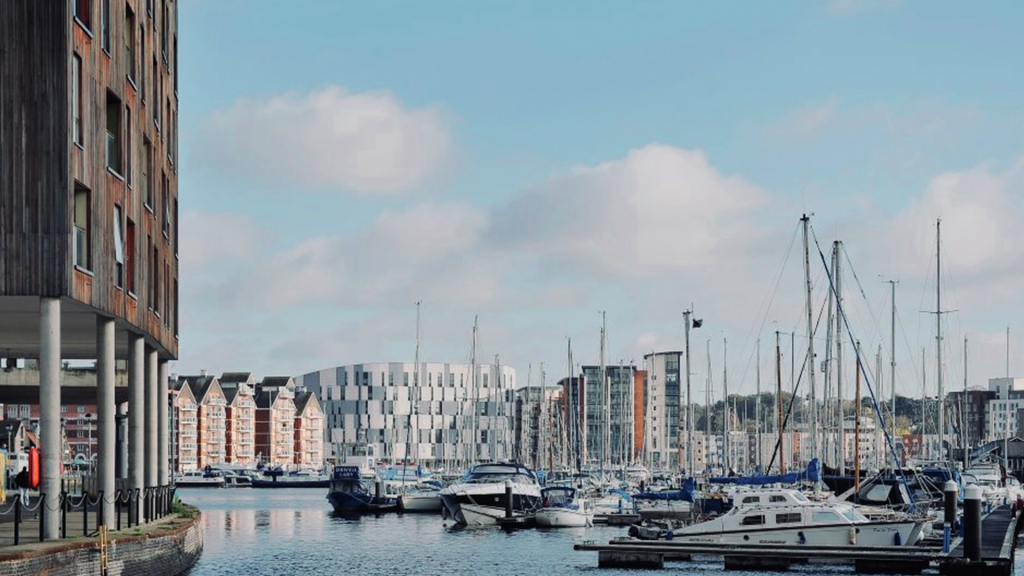
Ipswich is Suffolk’s county town and the commercial centre for the east of England. It’s a working port town. The centre and waterfront are being redeveloped with council and government funding. Entry prices are low enough for a first purchase.
Tenant demand doesn’t rest on one employer. Health and social care is the largest employer locally, anchored by Ipswich Hospital. Financial services run above the England average because of several long-established firms based in the town. The Port of Felixstowe, the UK’s busiest container port, sits around 12 miles south and feeds logistics work into Ipswich itself. Several industries hiring in the same town means your tenant pool doesn’t depend on one employer staying open.
Ipswich is the wrong town for anyone wanting to buy a property, refurbish it and sell within 12 months.

| Property type | Average price, last 12 months |
| Flat | £153,578 |
| Terraced | £235,593 |
| Semi-detached | £259,918 |
| Detached | £404,248 |
Source: Zoopla house prices, Ipswich
The town-wide average sold price is £267,079, up 1% on the year before but 4% below the 2023 peak of £279,302. Zoopla puts the same figure at £257,452 over a slightly different 12-month window. Both use HM Land Registry sold-price data over different reporting periods, so treat either as a guide and check live listings before you buy.
Flats are the cheapest way into Ipswich property investment, which is why waterfront and town centre apartments suit first-time landlords.
The average Ipswich property price is still 4% below where it peaked in 2023, 3 years on. House prices here move back up slowly, so plan to hold for years rather than months.
| Postcode | Average price | What it suits |
| IP2 (Chantry, Stoke Park) | £229,327 | The lowest entry price in the town. Flats here average £120,378 |
| IP1 (town centre, waterfront) | £250,494 | Flats and conversions, income-focused buyers |
| IP3 | £262,296 | Mid-priced stock, closest to the town average |
| IP4 | £301,194 | Rising prices and family-sized homes |
| IP5 (Kesgrave, Martlesham) | £345,460 | Commuter villages and larger detached homes |
Source: Rightmove house prices by postcode (IP1, IP2, IP3, IP4, IP5)
Over the past year IP4 rose 6%, IP2 held flat and IP1 fell 4%, which leaves IP1 7% below its own 2023 peak.
IP1 and IP2 cost the least and return the most rent per pound spent. IP4 and IP5 cost more and suit buyers who want family-sized homes and value growth ahead of monthly income.
Gross yield is one year’s rent divided by the purchase price, before any costs come out. Landlords use it to compare one property against another. Our guide to what counts as a good rental yield puts a healthy gross yield at 5% to 6%, with anything above 7% excellent.
No independently verified, postcode-level rent figure is published for Ipswich. The average rent across the East of England was £1,324 a month in June 2026, up 1.5% on the year before. Set against the postcode prices above, that gives:
| Postcode | Average price | Illustrative gross yield |
| IP2 | £229,327 | 6.9% |
| IP1 | £250,494 | 6.3% |
| IP3 | £262,296 | 6.1% |
| Town-wide | £267,079 | 5.9% |
| IP4 | £301,194 | 5.3% |
| IP5 | £345,460 | 4.6% |
Our own calculation: the East of England average rent, annualised, divided by each postcode’s average sold price. A guide for comparing postcodes against each other, not a projection for any single property.
Four of those six illustrative gross yields clear 5%. IP1 and IP2 sit close to the 7% mark, which is why income-focused buyers start with those two postcodes.
Real rents depend on a property’s size and condition. A one-bedroom flat in IP2 and a four-bedroom house in IP5 won’t both rent at a figure scaled from the same regional average, so use the table to compare postcodes and then price the specific property you’re buying.

| Project | What it is | Why a landlord should care |
| Town Deal | £25 million across 11 projects, delivered by Ipswich Borough Council | Town centre and waterfront improvements in the postcodes with the cheapest stock |
| Pride in Place | £20 million for neighbourhood improvement, including Whitehouse and Stoke Park | Money going into IP1 and IP2 areas, where entry prices are lowest |
| Freeport East | Covers the Port of Felixstowe, Harwich and the Gateway 14 site near Stowmarket. Forecast to create 13,500 jobs, with business rates reinvested locally | Jobs within commuting distance of Ipswich, which supports tenant demand |
| Ipswich Garden Suburb | A large housing expansion at Henley Gate, north of the town | New rental catchments as it’s built out |
Sources: Ipswich Borough Council inward investment and Freeport East. Job and funding numbers are the figures published by the bodies delivering the projects.
The University of Suffolk’s growing presence in the town centre adds to demand for flats near the waterfront.

Sailmakers Lofts is Prosperity Wealth’s Ipswich development, a residential conversion of 26 one and two bedroom apartments in the town centre.
| Location | Ipswich town centre |
| Type | Luxury residential conversion |
| Units | 26 one and two bedroom apartments |
| Price | £139,995 to £189,995 |
| Payment plan from | £1,749 a month |
| Quoted yield | 6% |
| Completion | Q2 2025 |
At the £139,995 entry price, a 30% deposit is £42,000 and a 5% reservation is £7,000.
Sailmakers 2 is our 2nd Ipswich property investment development that is currently under construction.
You can view Prosperity Wealth’s current and under-construction sites across the UK on our developments page. Head to this page to see our latest property developments first.
There’s more than one route into Ipswich rental property. The right one depends on how soon you need the rent.
| Route | What you’re buying | Suits you if |
| Standard buy-to-let | An existing terrace or flat, let on an assured shorthold tenancy | You want rent from day one and can handle older stock and its maintenance |
| New build | A finished, recently built property | You want low maintenance and the better energy rating tenants now ask about |
| Off-plan | A property before or during construction, at below its finished value | You can wait for the build to finish in exchange for a lower entry price |
Our beginner’s guide to UK property investment explains each route in plain terms.
The biggest cost in any Ipswich property investment is the deposit. Most lenders want at least 25% of the property’s value on a buy-to-let mortgage. Some accept 20%. In IP2 that’s £57,300 to £68,800 depending on the lender. In IP5 it’s £86,400 to £103,600. That deposit has to be in cash and in place before completion.
| Standard route | Prosperity Wealth payment plan | |
| To get started | 25% to 30% of the price, in cash | A 5% reservation |
| Rest of the deposit | Saved up before you buy | Paid monthly across the build period, around 24 months |
| Mortgage | You arrange it | Arranged in-house at completion, for the remaining 70% |
| At a £139,995 price | £35,000 to £42,000 upfront | £7,000 to reserve, then monthly instalments |
Every Ipswich property investment carries risk. These are the things specific to this town.
Prosperity Wealth connects investors with buy-to-let property across the UK and is part of Prosperity Group. Across the group, 4,126 homes have been developed across 50 schemes, with a gross development value of £509 million. This figure is what the schemes are worth when they are finished.
Prosperity Wealth’s Ipswich development: Sailmakers Lofts was made up of 26 apartments, priced from £139,995 which was completed in Quarter 2 of 2025.
What makes Prosperity Wealth unique is our property investment payment plan, which removes the need for a lump sum. The payment plan works wherever you buy. If the east of England appeals for the reasons above, or if you’re after the nearest comparison then take a look at property investment in Norfolk.
We can also manage all aspects of the property purchasing process with our in-house sales, mortgages, lettings and management teams. You don’t have to find a broker, an estate agency or management company, these are all in place should you need them.
Contact us today to find out how we can support your Ipswich property investment. Call +44 (0) 121 237 4610, use live chat or send a message through our contact page.
No one can promise a boom in Ipswich house prices. Be wary of anyone who does. What the town has is funded investment. Freeport East is forecast to create 13,500 jobs around the Port of Felixstowe, the waterfront and the Ipswich Garden Suburb are being built out and Ipswich Borough Council has £25 million going into 11 town centre projects. Ipswich also picks up rental demand from people priced out of Cambridge and the towns closer to London. Those things support gradual growth in Ipswich property prices rather than a sudden spike, which is the safer outcome for a landlord anyway.
House prices across Ipswich are not all falling, though the figures are different in the different areas. The average Ipswich property price rose 1% over the past year to £267,079, though it still sits 4% below the peak it reached in 2023. Individual postcodes move differently: IP4 rose 6% over the year while IP1 fell 4% and IP2 held flat. Check the sold prices for the postcode you’re buying in rather than relying on the town-wide average.
A good gross rental yield on an Ipswich buy-to-let is 5% to 6%. Anything above 7% counts as excellent. Applying the East of England average rent to Ipswich sold prices gives illustrative gross yields of 4.6% in IP5 up to 6.9% in IP2, so IP1 and IP2 are the postcodes to check first if rental income is your priority. No verified postcode-level yield figure is published for Ipswich, so treat those numbers as a starting point and work out the yield on the specific property you’re buying.
Most buy-to-let lenders want a deposit of at least 25% of the property’s value. Some accept 20%. On Ipswich house prices, a 25% deposit is roughly £57,300 in the cheaper IP2 postcode and £86,400 in IP5. The Prosperity Wealth payment plan works differently: you reserve an apartment with 5%, then build a 30% deposit in monthly instalments across the build period instead of finding the full amount upfront.
The 2% rule is an American shortcut for screening rental property. It says a rental only works if the monthly rent is at least 2% of the purchase price, so £4,000 a month on a £200,000 home. It almost never holds in the UK and Ipswich is no exception. Even the illustrative 6.9% gross yield in IP2 works out at roughly 0.6% of the purchase price per month, so treat the 2% rule as a filter used in much higher-yield markets rather than a target to expect from an Ipswich property investment.
Prosperity Wealth takes a structured approach to property investment, from our unique payment plan that reduces the upfront capital needed, through to development, sales and ongoing management once you own the property. If you are new to this type of investment, our beginners guide to buy-to-let property is a good place to start, and you can see our current UK property developments for opportunities beyond Ipswich.
Contact us today to find out how we can support your UK property investment journey. You can call us on +44 (0) 121 237 4610, speak to us via our live chat, or send us a message via the form on our contact page.